
Got Jam?
I’m quite partial to some Jam, but only the raspberry kind. GPS Jam? Not so much.

Remember the post about the Monolith?
We posted a while ago about being wary of the monolith. Unfortunately for us and for anyone else offering GPS tracking services, the more popular we (all) become, the more we become the monolith and thieves will target the common thread.
That is, thieves are going to assume you have a GPS tracker and they’re going to try and jam it. Already they’re scanning for (and finding!) Apple AirTags and other Bluetooth beacons such as the Google “Find My” trackers, and others. GPS is just the next target and thieves will just buy GPS Jammers from AliExpress or wherever they are made available.
It doesn’t matter that GPS Jammers are illegal. Coz, you know, so is stealing cars.
What does this mean for the customer?
What it means is that there is an increasing chance that during a theft event, thieves will jam the GPS tracker. Currently it’s common for cars to be stolen, then temporarily dumped in a remote location while the thieves wait to see if it has a tracker on it (i.e., if the police or owner arrives and recovers the vehicle).
We’ve got you covered.
A few weeks ago I also posted about how my brain hurts. Some of you may have guessed that post was about making sure our GPS Jamming detection and response systems were working, and you would be right.
It took us until now to make sure it worked really well before announcing it. And so, while it was already working for a bit, we are now officially announcing our GPS Jamming detection and response capabilities!
How does it work?
Simply, if your GPS tracker is jammed or can’t get a GPS signal, our systems will automatically track your vehicle location via Geolocation, also called Location Based Services (LBS) using mobile network information.
You don’t need to do anything. It just works!
If your GPS tracker suffers GPS jamming, an alarm is sent to your mobile phone and all position data in the ImmoTrack Online portal (whether via your mobile app or a web browser) will show the vehicle position and the level of accuracy. Shown below is a vehicle with two GPS trackers installed - one jammed, one not.
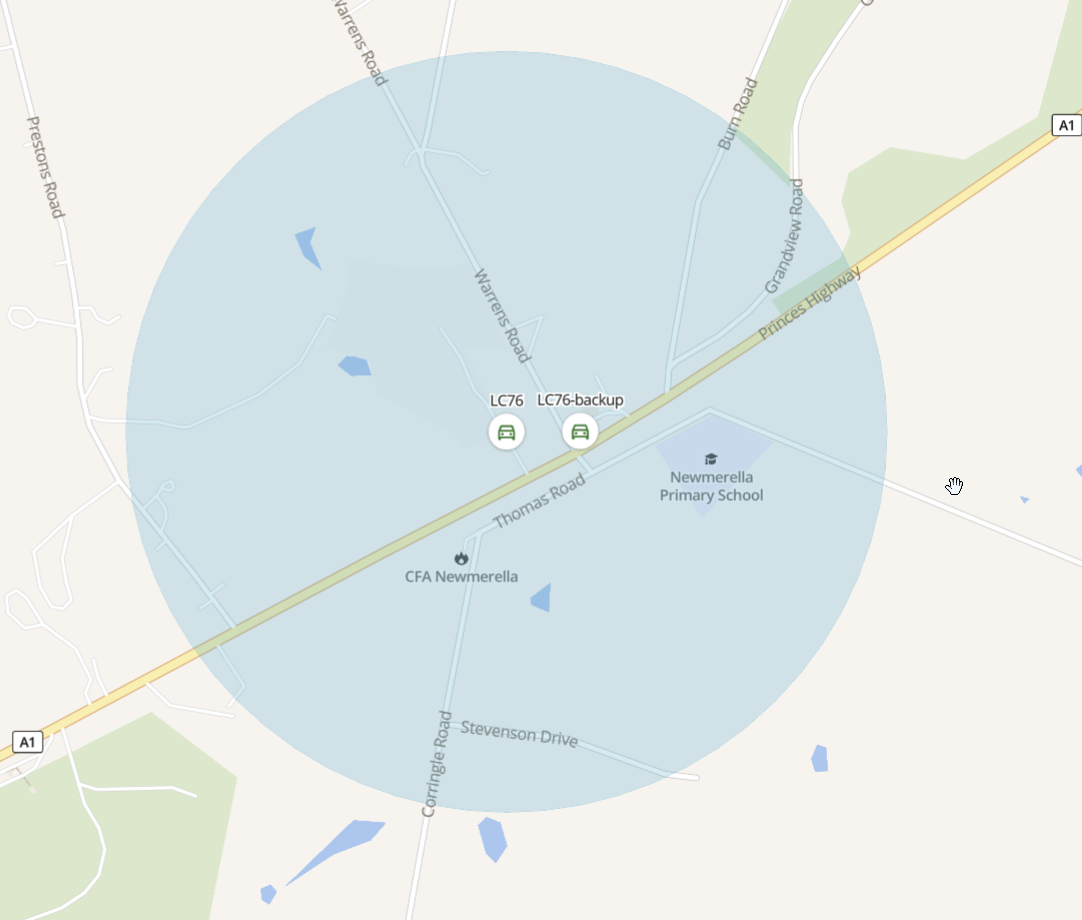
LC76 in this image is the jammed GPS tracker. LC76-backup is another non-jammed GPS tracker in the same vehicle. The backup is accurate to 2 metres, whereas LC76 here is accurate to "somewhere within the blue circle”.
Obviously, tracking a vehicle via cell tower data is not as accurate as GPS. Whereas with GPS you’re looking at 2-5 metres of accuracy, LBS will be - based on conditions! - from 100 square metres to a worst case of about 1,500 square metres in suburban areas. Out in the bush it can be worse - especially if there is only a single cell tower in range.
I will hang my hat though on the fact that even out bush, this is way better than not knowing at all!
Final thoughts
Now for a little more context, which was the reason we posted about my brain hurting. Making this work for customers reliably is not easy. It’s actually really, really hard to get right. It took us hundreds of man hours to deal with the edge cases, some of which I will mention here:
What is jamming? Is it a real jamming attempt or a false detection of jamming? How do you make sure you avoid those false detections?
What if the GPS signal drops for 10 seconds, do we geolocate (and make the car appear as if it just teleported a few hundred meters to where the geolocation engine believes it is) or do we wait and see?
Do we say the tracker is jammed if it just got flipped upside down?
How do we handle geofence alerts when vehicles teleport outside the geofence (but probably didn’t actually move)?
All of these were overcome, but they are not overcome just by flipping switches in the GPS tracker settings or in the server software.
Put simply, if you get told that the GPS tracker in your vehicle can handle jamming, don’t just take it on face value.
Ask for the receipts.
